
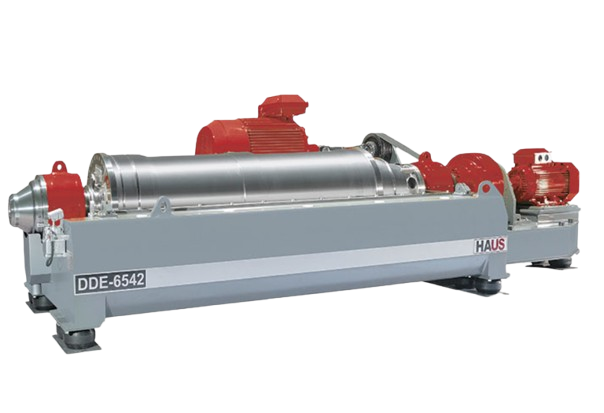
A centrifuge decanter; consists of a solid cylindirical bowl rotating at high speed, a scroll rotating at the same axis with a slightly different speed, a drive group adjusting the speed difference and the body which carries all the rotating elements.
Liquid and suspended solids are fed along the centre line to a distribution room within the bowl and then accelerated into the bowl by centrifugal force through the feeding point. This centrifugal force then causes the suspended solids to settle and accumulate at the bowl wall.
Sludge cake is discharged by scroll from the conical part meanwhile clarified liquid flows back along the bowl and is discharged through the cylindirical end of the bowl by plates which can adjust the level of clarified liquid.
Centrifuge decanters are applied for separation of liquid mixtures, separation of solid-liquid mixtures, dewatering, thickening, classification of solid-liquid mixtures and extraction of components.
DRIVE SYSTEMS
HAUS applies advanced engineering techniques to accelerate the decanters to high speeds in safe. One of the most important key factor for decanters is the differential speed. Differential speed determines the amount of moisture hold in the separated solids and the clarity of the centrate. This speed can be adjusted according to the required product characteristics. Drive systems which run to determine this speed are given as below:
1. Constant Speed Drive System
This system has low Investment costs due to very simple design. This drive system is used when the solids amount is constant, the solids can be conveyed easily and the amount of moisture in the solids is not critical, which means it is not necessary to adjust the differential speed.
2. Dual Drive System
Dual Drive provides differential speed to be adjusted in a wide range. Second motor drives the gearbox input shaft and makes the differential speed as a function of bowl speed and gearbox rate. Required speed is adjusted when the solids amount is variable noticeably, it is hard to convey the solids and it is important to minimize the amount of water hold in the solids without any human interference. Differential speed is adjusted automatically and very precisely as a function of scroll torque. The system is supported by the software developed by HAUS.
3. Semi - Driver System with Hydraulic Motor
Instead of a mechanical gear, a rotating hydraulic drive is assembled and this motor is supported with hydraulic regulation. Automatic regulation can be done with no problem because the differential speed is directly proportional with the amount of the oil transmitted. Driver system with hydraulic motor is used when the solids amount is variable, it is hard to convey the solids and it is important to minimize the amount of water hold in the solids.
ADVANTAGES OF THE DECANTER
Decanter provides the advantage of high efficiency operation compared to traditional separation systems. It was necessary to develop continuing systems in order to reduce the increasing company costs and for the growing industry to be able to adjust itself to the acquired achievements.
Application flexibility
Decanters provide practically high efficiency results under fluctuations at product inlet, differences in process conditions and even at different characteristics of various products. This capability enables reliable and regular operation.
Operational conditions
Appropriate body designs and isolation systems can be applied for steam proof or pressurized processes between 0-8 bars. Tailor made designs and machinery designs are available for cleaning in place (CIP) systems to be used in extremely low and extremely high temperature conditions, explosive atmosphere standards and hygienic environments.
Automation
Operation of the decanter became fully automatic with the use of modern devices and control units. The ability to control whole facility from a central control room enables the decanter to be operated with no personnel.
Corrosion and wear protection
Process specific materials highly resistant to corrosion and abrasion are used in decanter manufacturing.
Low space requirement
With its excellent design and high processing capacity, the decanter requires a lot less space compared to alternative systems.
DECANTER APPLICATIONS
Decanters are used in a wide range of industrial areas. Decanters are used in separation of liquid mixtures, separation of solid-liquid mixtures, dewatering, thickening, classification of solids and extraction of components.
INDUSTRIAL APPLICATIONS - I SERIES
Oil and Fat Processing:
- Clarification of press oil
- Rendering applications
- Biodiesel application
Oil and Fat Recovery:
- Fat and/ or animal bone meal
- Blood plasma and/ or blood meal
- Edible fats
- Animal origin fat recovery
- Beefbroth
- Gelatin
- Fish meal and fish oil extraction
- Coconut Oil
- DAFSludge
- Technical fats, cocoa butter, olive oil and palm oil
Oil Fields:
- Slop oil recovery
- Tank bottom oil recovery
- Oil recovery from lagoons
Available in:
2-Phase Decanter
This technology is developed for applications requiring solid-liquid separation. Separating two liquids in a single equipment has simplified many processes.
3-Phase Decanter
This technology is developed for applications requiring solid-liquid-liquid separation.
HAUS DECANTER CENTRIFUGES
PRODUCT GROUPS AND MODELS
HAUS offers its customers a wide range of products.
HAUS manufactures decanters of diameters from 238 mm to 820 mm in different lengths and configurations. It is possible to process products from 1 m³/h up to 250 m³/h with these decanters.

Representative HAUS Decanter Centrifuge Models
| MODEL | 2342 | 3532 | 3542 | 4042 | 4742 | 5342 | 6542 | 8242 |
|---|---|---|---|---|---|---|---|---|
| COMPACT | COMPACT | COMPACT | MEDIUM | MEDIUM | LARGE | LARGE | EXTRA LARGE | |
| LENGTH (mm) | 2,362 | 3,204 | 3,585 | 3,583 | 4,882 | 5,406 | — | 5,780 |
| WIDTH (mm) | 827 | 830 | 830 | 1,002 | 1,225 | 1,671 | — | 2,421 |
| HEIGHT (mm) | 974 | 1,034 | 1,034 | 1,310 | 1,300 | 1,583 | — | 1,749 |
| WEIGHT (kN) | 8.4 | 17.6 | 20.6 | 23 | 44 | 95 | — | 155 |
| TYPICAL CAPACITY (m³/h)* | 2 - 5 | 6 - 15* | 6 - 15 | 12 - 25 | 20 - 35 | 25 - 100 | — | 65 - 150 |
| DRY SOLIDS LOAD (kg DS/h)* | 60 - 160 | 200 - 400* | 250 - 500 | 350 - 700 | 500 - 1,000 | 600 - 3,200 | — | 900 - 4,000 |
| BOWL DIAMETER (mm) | 238 | 350 | 350 | 400 | 450 | 650 | — | 820 |
CAPACITY CLASSIFICATION
- COMPACT: 2342, 3532, 3542
- MEDIUM: 4042, 4742
- LARGE: 5342, 6542
- EXTRA LARGE: 8242
NOTES
- Typical capacity and dry solids load values are indicative for wastewater/sludge applications.
- Actual performance may vary depending on feed characteristics, solids concentration, required dryness and operating conditions.
- The capacity range of HAUS decanter centrifuges is from approximately 1 m³/h up to 250 m³/h.
- Model 3532 capacity is estimated based on bowl diameter and position between 2342 and 3542 models.
Need a Decanter Configuration for Your Process?
Our engineers will help you select the right HAUS Decanter model and drive system for your application.